Honoring Black Mariners

HONORING BLACK MARINERS HEADER

Honoring Black Mariners 

In honor of Black History Month, we’re taking a look at a few of the patriotic Black Mariners who served on the seas in development and defense of our country. Below is a look at eight of the many whose stories are intertwined with the nation’s military history, growth of the nation, and the ongoing struggle for racial justice in the United States. 


First to Receive Navy Cross
Doris “Dorie” Miller. Waco, TX.

1919-1941

Miller served on board the battleship West Virginia as a US Navy Cook Third Class. During the attack on Pearl Harbor, where he lost his life, he manned an anti-aircraft gun and shot down several Japanese planes despite having no training on the gun. He also assisted several of the severely wounded, including the ship’s captain, to safety. He is the first Black American to receive the Navy Cross, the second highest service decoration for valor in combat.

First Ship Master
Carl Bashear. Tonieville, KY.

1931-2006

Bashear was a US Navy Master Chief Petty Officer serving as a master diver despite a leg amputation from a service wound in 1966. The film Men of Honor starring Cuba Gooding, Jr. is based on his life. He enlisted in the Navy in 1948 after it was desegregated by President Truman and was the first African-American to attend and graduate Diving and Salvage School, based in Bayonne, NJ. He received the Navy & Marine Corps Medal, Commendation Medal, and Achievement Medal. 


First Revolutionary War Casualty
Crispus Attucks. Framingham, MA.

1723-1770

The son of a slave, Attucks is believed to have escaped slavery himself. He was the first casualty in the American Revolution fighting the British at the Boston Massacre. He worked the docks in Boston, MA and was also a sailor under threat as a colonial mariner to be conscripted into the British Navy.

His body was laid in state at Faneuil Hall and city leaders waived segregation laws to bury Attucks with his fellow fallen. The British soldiers responsible for Attucks and the other colonists death in the Boston Massacre were famously defended by John Adams as part of ongoing American tradition that everyone is entitled to a defense.

Marine Innovator
James Forten. Philadelphia, PA.

1766-1842

Forten was known in his later years as an ardent Abolitionist and one of the wealthiest entrepreneurs in Philadelphia, owning one of the city’s most successful sail lofts at Penns Landing on the Delaware River. He developed a tool that allowed his loft to easily maneuver large sails being manufactured for the ships of the day.

He served in the Revolutionary War at age 14 aboard the private vessel Royal Louis, one of several privateers used for naval combat to support the new Continental Navy. He was captured by the British and became a POW on the HMS Jersey before being transported to the Brooklyn Navy Yard. When released, he walked home to Philadelphia and began work landside supporting the maritime industry. 


First Ship Master
Hugh Mulzac. British West Indies.

1886-1971

Considered America’s first African-American ship master, Mulzac was born into a family that built whaling ships and schooners in the Caribbean. He started his sea life on British schooners and emigrated to the U.S. in 1918 where he earned his shipping master’s certificate in the Merchant Marine, the first ever issued to an African-American. Although he qualified as a captain, he was not offered a berth for 20 years due to discrimination and first worked as a steward.
  In WWII, at age 56, he was offered and initially refused command of the SS Booker T. Washington when he insisted on an integrated crew. He eventually was offered the position under his terms and became the first Black Officer to command an integrated ship. He was a strong labor leader and was blacklisted during McCarthyism. 


Union Civil War Navy Hero
John Lawson. Philadelphia, PA.

1837-1919

Lawson enlisted in the U.S. Navy to fight for the Union during the Civil War. He was injured at the Battle of Mobile Bay while serving aboard the USS Hartford, and received the Navy’s Medal of Honor for, while wounded, continuing to supply the Hartford’s guns. The Hartford is the ship where Rear Admiral David Farragut famously had himself tied to the mast to better view the battle. Lawson also received the Navy Grand Army of the Republic Medal. 


First Warship Named
Leonard Roy Harmon. Cuero, TX.

1917-1942

Harmon as an American sailor who enlisted in the Navy at age 22 to serve during WWII as a Mess Attendant, the only open position to Black sailors at the time. Harmon died in action on board the USS San Francisco in Guadalcanal. He was posthumously awarded the Navy Cross, received three battle stars, and is the first African-American to have a US Warship named after him. The USS Harmon was commissioned in 1943 transiting the Panama Canal with the 3rd fleet. The vessel ended her years after decommissioning with the North American Smelting Company, Wilmington, DE. 


Spanish-American War Hero
Robert Penn. City Point, VA.

1872-1912

Penn served as a Fireman First Class in the US Navy on the USS Iowa during the Spanish-American War. He was awarded the Navy’s highest military decoration — the Medal of Honor — for his actions off the coast of Cuba after a boiler accident. 
The Road to the Ferry: Lewes

Which Road Should I Take to the Ferry in Lewes?

As with most destinations in life, there are a few ways to get where you’re going, and that’s also true for the Ferry terminal in Lewes, Delaware. You can go through the town of Lewes, but you can also by-pass the town and get to the Ferry via Freeman Highway, a route that is a bit different from standard state roads, and has an interesting history. And, as with most things related to the Delaware River & Bay Authority, the operating Authority for the Cape May-Lewes Ferry, the history has both aviation and maritime overtones with a touch of bridging the past to the present.

How Did the Highway Get It’s Name?

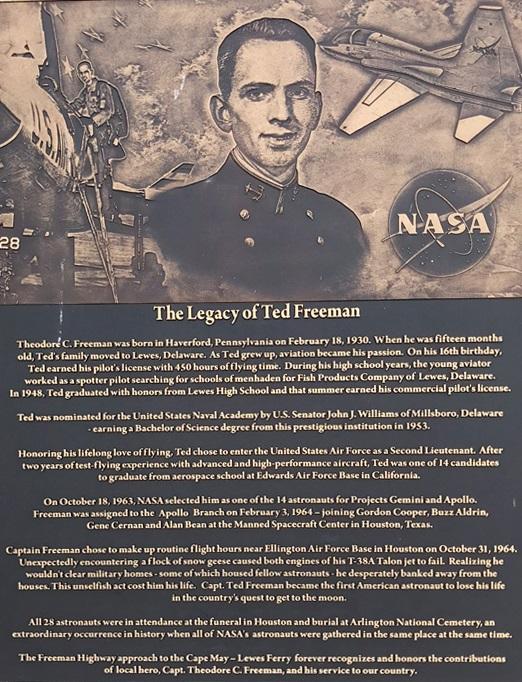
Freeman Highway is named after Theodore “Ted” Freeman, an aeronautical engineer, USAF test pilot, and NASA astronaut. Captain Theodore Freeman grew up in Lewes, Delaware to a family of farmers and carpenters. He worked part-time at local air fields refueling planes and doing maintenance to earn pocket money, which he largely spent  taking plane rides and on flying lessons. Once he gained his pilot’s license at age 16, he used his entrepreneurial skills to help commercial fishermen by spotting fish for them from the air. By the time Freeman graduated high school he had applied to the US Naval Academy.

For More on Ted Freeman: The Man Behind The Highway

Captain Freeman died in an aviation accident in 1964, the same year the Ferry began operations. Almost immediately, the Ferry Access road being built by the DRBA was slated to become Freeman Highway in honor of the local hero. On December 21, 1965, the Delaware State Senate formalized the name by resolution and Freeman Highway opened as a Delaware extension of Rt. 9 in 1966.  An historical plaque is located at the corner of the Lewes Terminal and was dedicated to Ted Freeman on June 18, 2014 as part of the 50th anniversary of the Ferry.

Related Story: The Road to the Ferry: Cape May

Who Handles Road Maintenance?

Similar to how the DRBA maintains the Ferry approach roads in Cape May, the Authority has responsibility for Freeman Highway operations, which represent approximately 1.5 miles of roadway. By agreement with local officials, the DRBA built the two-lane road in 1964 as a by-pass to alleviate potential traffic clogs through the center of Lewes. Today, Freeman Highway remains a DRBA road maintained by the Ferry and the DRBA and not the Delaware Dept. of Transportation, like most of the surrounding roadways.

The lanes were originally constructed in concrete and the highway still has a concrete base now sealed with an asphalt top that effectively extended the initial 50-year life of the concrete. Although the asphalt helped protect the concrete bed underneath, it had a life expectancy of 20 years, and is now due for an upgrade. Since asphalt is weather sensitive, the work is ideally done in warmer weather months and is expected to begin on March 27 and be completed in two months — or mid-May — in time for the launch of the Summer 2022 travel season on Memorial Day Weekend.

To update the road, DRBA engineering teams and contractors will mill down 3 inches of  asphalt and patching concrete as needed. “Our goal is to minimize lane closures,” commented DRBA Project Engineer Brent Van Lith. Van Lith noted that most of the work will be done at night or at hours that have little impact on Ferry traffic.

“Unlike standard road projects, we take Ferry traffic into account,” Van Lith added. Freeman Highway was created specifically as a Ferry Access road, although today, it  is also used by many other travelers between Cape Henlopen State Park, beach homes and King’s Highway. The full project is estimated to cost the DRBA  $1,077,777.

Check Out The Latest Edition of the Twin Capes Traveller!

The Road to the Ferry: Cape May

Which Road Should I Take to The Ferry in Cape May?

This is a common question received by the customer service phone teams at the Cape May-Lewes Ferry, but the answer is not as simple as you might think. You could take either Lincoln Boulevard, Rt. 9, Ferry Road, or Sandman Boulevard to get to the Ferry. That’s because each are different names for the same stretch of road! 

Which name you use can say a lot about you. It can either date you, determine how local you are, or show if you’re a devotee of Waze or Google Maps for getting directions. Here’s a bit of local history to help untangle the road’s multiple labels.

Maritime Importance of Route 9

Depending on your direction of travel, the road is considered the beginning or end of Route 9 in New Jersey. According to one article from NJ.com, Rt. 9 is New Jersey’s liveliest highway, and when traveled in its entirety through the state provides the best representation of everything Jersey.

It starts, when traveling south, from the George Washington Bridge and ends at the Cape May-Lewes Ferry. What many people don’t realize, however, is that Rt. 9 doesn’t end at the Delaware Bay at all but continues as a maritime route connected by none other than the Cape May-Lewes Ferry! In August 2021, the route received a second, official MARAD designation naming the Delaware Bay crossing as part of America’s M95 Marine Highway– the marine equivalent of I-95 on the coast.

Rt. 9 is part of US Highway history as it is one of only two US Highways connected by a maritime component, and the only one connecting a north-south route. The other, Rt. 10, is an east-west highway connected by the SS Badger over Lake Michigan. 

The Sandman Connection

If you’re a local history buff, you may know the name of Charles Sandman, Jr. Born in Philadelphia in 1921, Sandman grew up and was quintessential Jersey. When he graduated from then Cape May High School, he returned to Philadelphia to get his BA from Temple University, but subsequently got his law degree from Rutgers Law School in Newark. He then served in the Army Air Corps in WWII, and was held as a prisoner of war for seven months in Germany.

At age 33 Sandman started his political career, and was elected to three consecutive 4-year terms as the NJ State Senator from Cape May. In the early 1960s, he became a passionate advocate for a ferry to connect South Jersey to southern Delaware helping pave the way to create the current Cape May-Lewes Ferry system that began in 1964.

Soon thereafter, in 1965, Sandman resigned his state post to become the US Congressman for District 1 in NJ and a member of the House Judiciary Committee. There, he received national fame becoming best known as the most prodigious defender of President Richard Nixon during impeachment hearings. Sandman only revoked his support after the revelation of the famous “smoking gun” tape. He ended his career as a chief judge of the family court in Cape May County.

When he died in 1985 at age 64, Sandman’s obituary appeared in The New York Times and Washington Post  in addition to state and local newspapers throughout the region. In honor of all Sandman did for South Jersey and the Ferry, the portion of Rt 9 from the Railroad tracks near Rt. 109 to Bayshore Road was renamed Sandman Boulevard in 1986. A historical marker was placed on the road renaming the segment as Sandman Boulevard.

Several online beach guides from KnowThisPlace.com to Delmarvabeachguide.com list the Ferry’s address as 1200 Sandman Boulevard, but that address was never technically correct as the segment of Rt. 9 from Bayshore Road to the Ferry staging lanes and parking lots is Lincoln Boulevard.  The Ferry’s local address has always been 1200 Lincoln Boulevard in line with post office norms, but mail addressed to 1200 Sandman Boulevard is still delivered as everyone knows what the sender intended.

DRBA Widens Road

Because of its importance as the main access road to the ferry, the Delaware River & Bay Authority (DRBA) has always handled the road’s maintenance all the way from the Ferry to the Rt. 9/Rt.109 intersection. When the DRBA funded new road construction in 2012, it made local news (see headline above), and the historical marker was saved in a DRBA warehouse to protect it from ongoing construction work.

Related Story: The Road to the Ferry: Lewes

When the road reopened, the sign remained in storage. At the Ferry’s 50th anniversary celebrations in 2014, county and DRBA officials agreed to relocate and rededicate the marker in a place with higher visibility and placed it on the Ferry campus adjacent to the terminal in Cape May. It continues to stand there today welcoming visitors to the Ferry grounds with an updated plaque noting its original position.

The picture on the top of this page shows the Sandman family, many of whom still live and work in Cape May County, in attendance at the rededication ceremony.

The Ferry Road Nickname

Given all of the history, it’s clear the road needs no other names but — if you travel around Cape May — it’s not unusual to hear people talk about Ferry Road. It’s basically a nickname referring to the access road from Bay Shore to the Ferry aka Lincoln Boulevard. It’s possible locals started using it because the other three names — Lincoln, Sandman and Rt. 9 — were causing some confusion and the name Ferry Road clearly delineates it as the road that takes you to the Ferry. Where or when this name started is really not known. 

Catch the Best Sunsets in the World

Shipbuilding in the U.S.


The Shape of Shipyards

With the M/V New Jersey undergoing a complete lifecycle extension at the shipyard in Staten Island and the 2021 start of the Marine Master plan for the ferries of the future, it’s a good time to look at the role of shipyards.

It’s a story we don’t frequently tell and one that is both steeped in history, global defense positioning, and economic implications. If you buy a car, it’s important to know if there are mechanics and service stations nearby. Similarly, if you have a boat, it’s good to know the state of shipyards that help build and keep those boats in peak condition.


Shipyards and the Economy

Currently, there are 124 shipyards in the US across 26 states. Per a 2021 article in Maritime Executive, industry studies show shipyards support approximately 110,000 jobs across all 50 states and contribute $37.3 billion to the national Gross Domestic Product (GDP). 

An industry forecast by IBISWorld, a global business market research firm, anticipates continued shipyard growth through 2026 to support the need for defense, passenger and commercial vessels ranging from barges, submarines, tugboats, and fishing vessels to ferries like those that will be commissioned for the Cape May-Lewes Ferry. Nonetheless, the number of shipyards in close proximity to our ports that can handle our size and type of vessel are limited. 

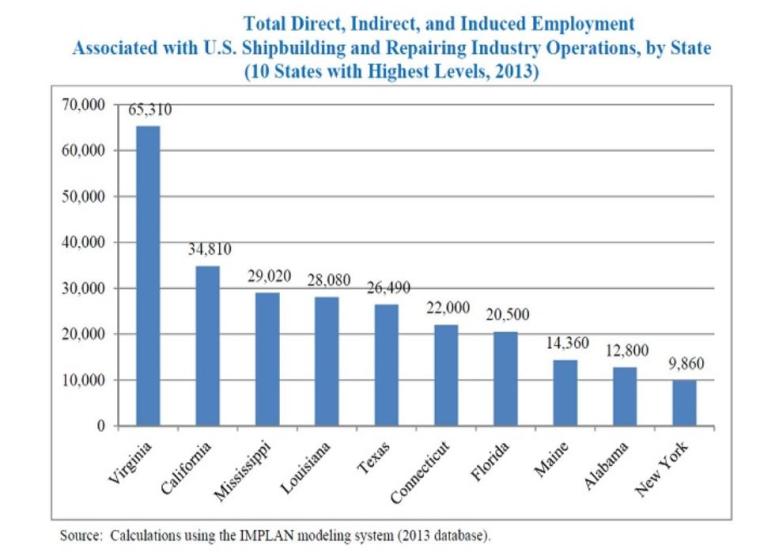
The chart below, taken from an economic study on the shipping industry in 2013 shows the top 10 states with shipbuilding capabilities, with the top 5 accounting for almost two-thirds of all private shipbuilding employment. For every shipbuilding job in the U.S., three indirect jobs are supported. Virginia, which tops the chart, is home to General Dynamics, the largest shipbuilder in the country and one that caters to specialty naval vessels. 

Image
Chart of Implan data on US shipyards

Finding Local Expertise

The lack of local resources is one of the reasons the Cape May-Lewes Ferry has a robust marine shop on premises for minor repairs. It’s why when a ferry from Martha’s Vineyard was sailing to a Chesapeake shipyard years ago and broke down in transit, repairs were done by the Cape May-Lewes Ferry team as the closest marine mechanics able to assist getting the Massachusetts ferry back underway.

Currently, the closest shipyards for larger types of mechanical repairs for our sized vessels are in Philadelphia followed by Staten Island, where the M/V New Jersey is currently being refurbished. Although some shipyards are closer to Cape May, they don’t have dry docks large enough for CMLF vessels and are generally designed to support smaller boats.

In 2017, the M/V NJ docked at Dorchester Shipyard near Port Norris, NJ —  located where the Delaware River flows into the Delaware Bay — for steelwork and painting upgrades. The repairs did not require full dry docking, and Dorchester, proud of winning the paint contract, published the YouTube video below.   

Where are the DE and NJ Shipyards?

You may notice that the current CMLF fleet carries the words “Wilmington, DE” on their bows. This is a tribute to the DRBA’s Delaware roots, but also the deep history of ferry boat building and passenger services that came out of Wilmington shipyards. Today, the Port of Wilmington is better known for cargo vessels as is the the nearby Port of Camden, but at one time both were major shipbuilding centers. 

Camden was important in WWII efforts, responsible for the launch of several legendary battleships including the USS South Dakota, USS Kitty Hawk, and 98 landing craft used at Normandy Beach. Ironically, the Camden shipyard was built in 1899 by Henry Morse, an engineer who originally wanted to have his shipyard in Staten Island but couldn’t find a suitable site. He subsequently named his Camden yard on the Delaware River — New York Shipbuilding Corporation!

Delaware’s shipbuilding history is based in Wilmington due to its proximity to both the Delaware and Christiana Rivers. At one time, there were four major shipbuilding plants along the Christiana and in WWII, Wilmington shipyards specialized in small water invasion craft and the famous Higgins boats, called the “boats that won the war.” Click the thumbnail below for a piece from CBS Sunday Morning on Higgins boats and how they were inspired by shallow draft skiffs on the Louisiana Bayou. 

Wilmington Ferry Lines

Of all the local DE and NJ shipping locations of yesteryear, Wilmington was the one that became known for shipyards that catered to ferry lines. Ferries in the Wilson Line, were built in Wilmington to take passengers up river to New Jersey and Philadelphia before rail and roadways could accommodate the traffic. The ferries specialized in day excursions. 

Today’s Debate

Today, the debate about shipyards involves the 1920 Jones Act, which requires that all goods and services shipped between US ports must be on ships built, owned, and operated by US citizens and permanent residents. Designed to stimulate shipping after WWI, many economists, defense experts and others argue it has had the opposite effect and resulted in limiting US maritime growth. 

The Jones Act has been cited in limiting trade and emergency response to Puerto Rico and affects the ability of American shipping lines to import services when needed. For future marine master planning at the CMLF, it means any boats ordered for our line will come from one of just a few available shipbuilders, as most US shipyards specialize in smaller boats or deep-water Navy vessels, with many ferry specialists currently located in Europe. This is one reason the Marine Master plans and designs provided by naval architecture consulting firm Elliott Bay must take into account shipbuilding capabilities available within U.S. shores as part of their consideration and recommendations.

Catch the Best Sunsets in the World

Must-Do Delaware Activities

Fun, Adventure, and Incredible Experiences In the First State!

Delaware might be small in stature, but it’s certainly not short on adventure. Whether your Delaware to-do list is focused on food, beer, history, outdoor adventure, luxury or any combination thereof, the First State offers plenty of opportunities to start checking things off! 

And while the suggestions here are our own, this post was inspired by the Ferry’s inclusion in the book 100 Things To Do in Delaware Before You Die, written by Dan Shortridge and Rachel Kipp, available now from Reedy Press. It’s an awesome book with an exhaustive list of must-visit places, things to do, and enough day-trip and weekend adventure ideas to keep you coming back to Delaware for years, so make sure to pick up a copy!

For History Buffs

Dive into Delaware's history!

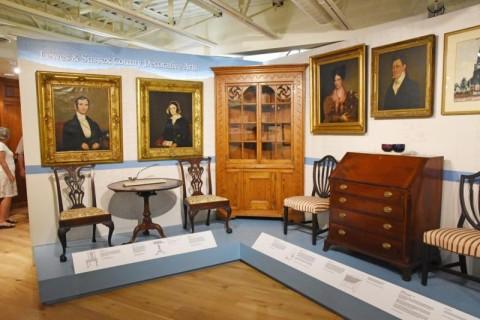
Display in Lewes History Museum

Historic Lewes: The First Town in the First State

Lewes, located immediately on the Delaware side as soon as you exit the Ferry, is a town steeped in history. From the Zwaanendael Museum to the Cannonball House, Life Saving Station, and so much more, there are enough historical adventures to keep even the most dedicated history buff busy. And for those nautically inclined, take special note of the long and storied maritime history of the area. We recommend starting off with a visit to the Lewes Historical Society to make a plan.

Fort Delaware: Visit A Civil War Prison on an Island in the Middle of the Delaware River!

 
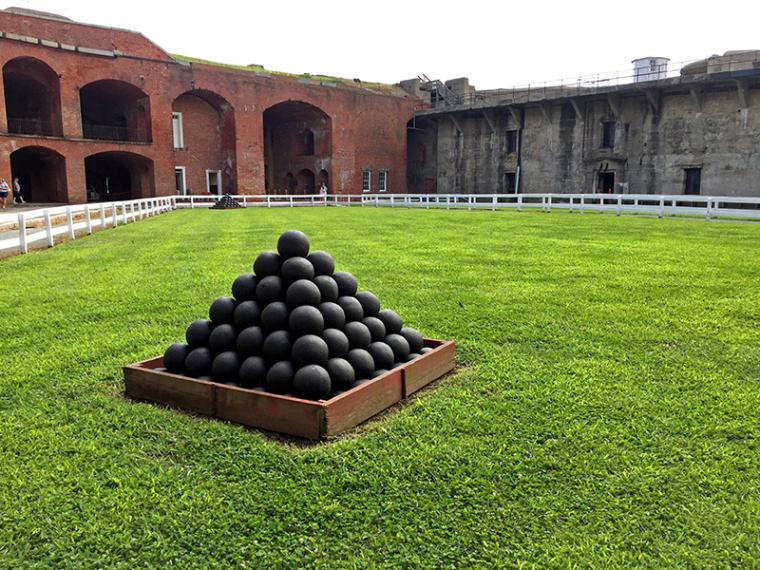
Civil War-era cannonballs seen at Fort Delaware on Pea Patch Island

Located on Pea Patch Island in the middle of the Delaware River, visiting Fort Delaware is like taking a step back in time! Accessible only by Ferry (the Delafort, which departs from Delaware City, DE and Fort Mott, NJ during the summer months), Fort Delaware offers a peak at what life was like during the Civil War. Beyond the history, Pea Patch Island is also home to nine different species of herons, egrets, and ibis, and is one of the largest wading bird nesting areas on the East Coast, so make sure to bring your binoculars and an interest in the local wildlife as well!

For The Outdoor Enthusiast

Options abound in the First State.

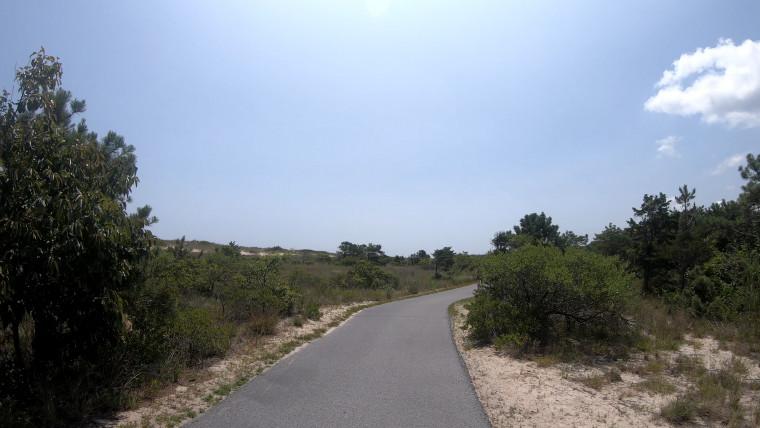
Bike Path Cape Henlopen

Cape Henlopen State Park

Did you know that there are hundreds of millions of acres of public land in the United States? Ranging from National Forests to State Parks, they’re held in the public trust for Americans to enjoy. And, one of the oldest examples of public land happens to be located just a mile down the road from the Lewes Terminal, at Cape Henlopen State Park. After being granted to him in the late 1600’s, William Penn proclaimed that Cape Henlopen and its natural resources were to be for the common usage of the citizens of Lewes and Sussex County, and the land has remained in the public domain ever since. 

Nowadays, you can go for a hike, or ride a bike on the network of trails (Gordon’s Pond is a great choice), hit the beach for some relaxation, surfing, fishing or boating, tour the Nature Center, check out the Beach Plum Nature Preserve, observe some military history, and even go camping!

For the Beer Lover

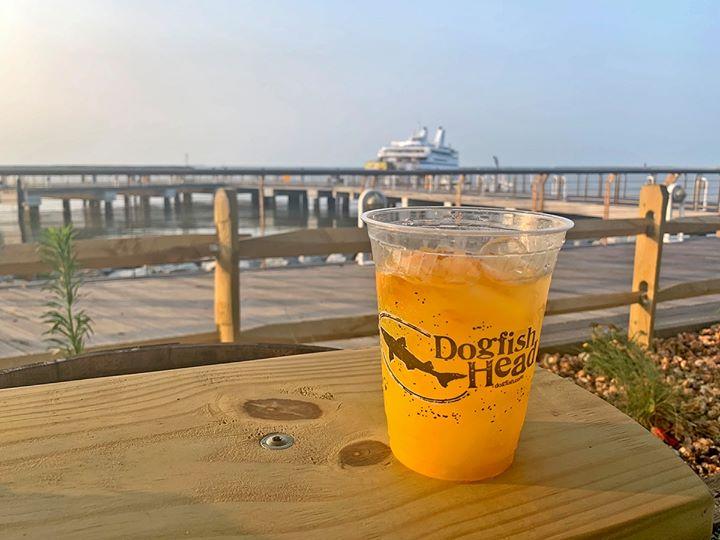
Dogfish Head

Pedal your way to a pint!

Delaware does a lot of things well, but two of the things it does best are bicycling, and craft beer. The state is consistently ranked as one of the best states for bicycling in the US (#6 in the most recent League of American Bicyclists rankings), offering a variety of options for everyone from serious cyclists to casual cruisers. It’s also home to some great beer. Check that, a lot of great beer. And, fortunately, we’ve mapped out a Pints & Pedals tour that combines both, all within ridable distance of the Lewes Ferry terminal!

For The Family Looking for Fun

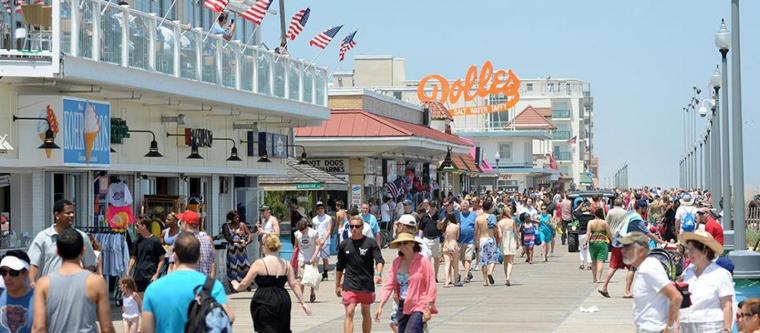
People walking on Rehoboth Beach Boardwalk

Rehoboth Beach and The Rehoboth Beach Boardwalk

Got a sweet tooth? Dolle’s is not just an iconic landmark, it’s got everything you could possibly need to feed your need (they’re famous for caramel corn and salt water taffy, both of which are must-try items). Beyond Dolle’s, there are plenty of options for ice cream, as well as a long list of places to grab a great snack, sit down for a meal, or pick-up something to go. Pop in and out of local shops and boutiques, run down to the beach, or just get some exercise on the mile-long stretch of boardwalk. 

For the Foodie

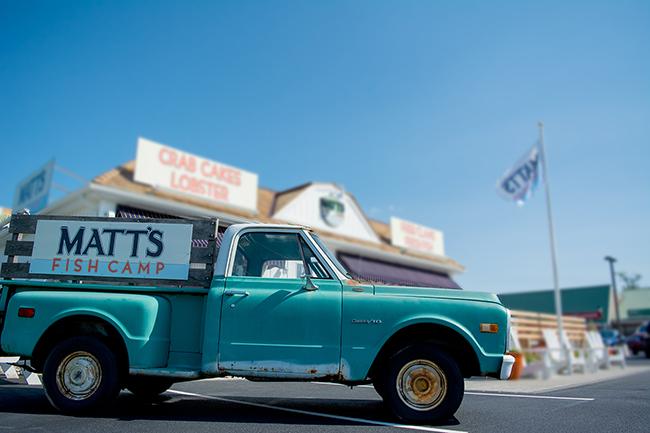
Matt's Fish Camp in Lewes, DE

Go on a Seafood Safari!

Spend any amount of time around the waters of the Delaware Bay or the Atlantic Ocean, and you’re bound to kick up a craving for some fresh seafood. Fortunately, Delaware has plenty of options to choose from! Whether you opt for a whirlwind tour or break it out into multiple trips (it’s a great excuse to keep coming back!), sampling seafood is always an amazing adventure. From Matt’s Fish Camp in Lewes to Fork + Flask, Dogfish Head’s Chesapeake & Maine, and the Henlopen City Oyster House in Rehoboth Beach, there are a myriad of options all within easy reach of the Lewes Ferry terminal. 

For the Nature Lover

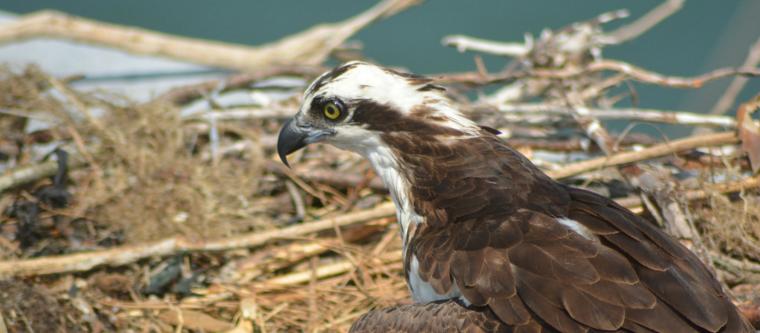
a bird

Break out the Bino’s!

Got an eye for wildlife? Great! Delaware offers some amazing opportunities to spot local species. In fact, you can start spotting right from the Ferry; we commonly see osprey, eagles, dolphins, and even a whale every now and then. Once you’re on land in Delaware, Cape Henlopen State Park offers a wide variety of options for wildlife watching. Or, if you’re up for a longer trip and want to see more of the First State, check out the locations on the Visit Delaware site.

DOLPHINS & WHALES

OH THE THINGS YOU'LL SEE

A Virtual Tour of Veterans Memorial Park

Honoring Our Veterans

November 11 is Veteran’s Day, and while we do what we can to honor our veterans here at the Ferry – including a special offer that provides veterans free transportation, free coffee, and 11% discounts on retail throughout the day – there’s no truly appropriate way to express our thanks.

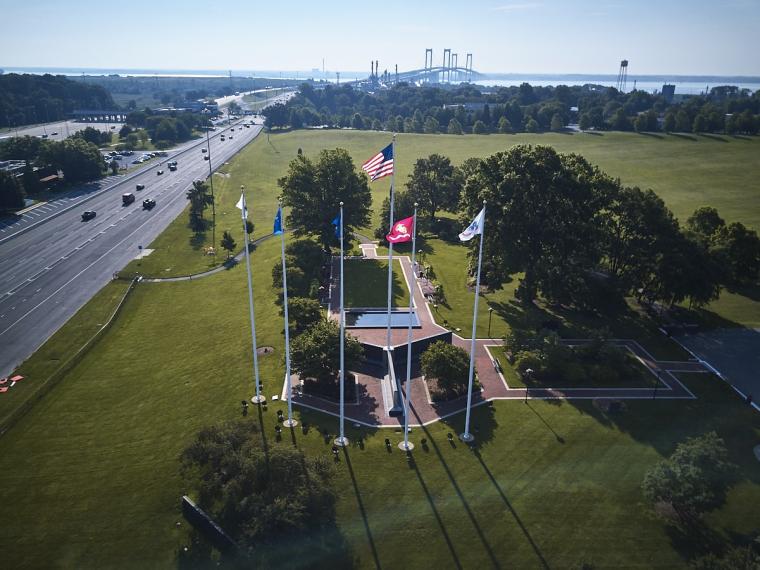
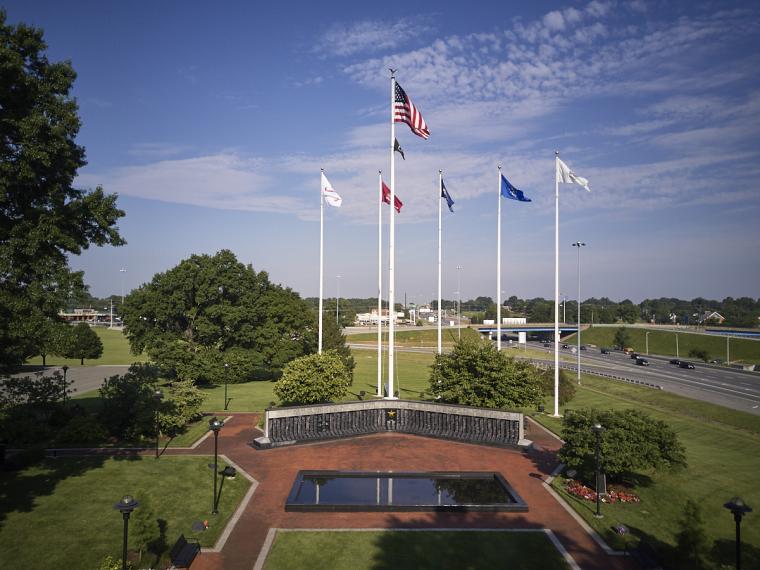
The day is typically honored at the Delaware Memorial Bridge Veterans Memorial Park (shown below) with services held by the Delaware Commission of Veterans Affairs.

If you’re unable to visit, or may not have had a chance to visit Veterans Memorial Park or spend time at each of the different monuments, read on and we’ll bring you along on a virtual tour of the Park.


The Delaware Memorial Bridge

Image
Aerial photo of Veteran's Memorial Park at the Delaware Memorial Bridge

Our virtual tour starts at the Delaware Memorial Bridge, because the bridge was named as a memorial to honor soldiers who gave their lives in WWll. The bridge was first authorized in 1945 and the first span opened to traffic in 1951.


Veterans Memorial Park

Image
Veterans Memorial Park at the DRBA's New Castle, DE campus

Veterans Memorial Park is located on the DRBA’s New Castle campus, across the highway from the DRBA complex beside the northbound lanes of I-295. The park land was set aside in 1955, before the Northbound second span was constructed. The official way to get to the park is to drive onto I-295S to Rt.9S and cross over Rt. 9 to be on Cherry Lane, with the park entrance located 200 yards down on the left. In good weather months, this is a great place to eat your lunch outside and tour the monuments.


The Gold Star Monument

Image
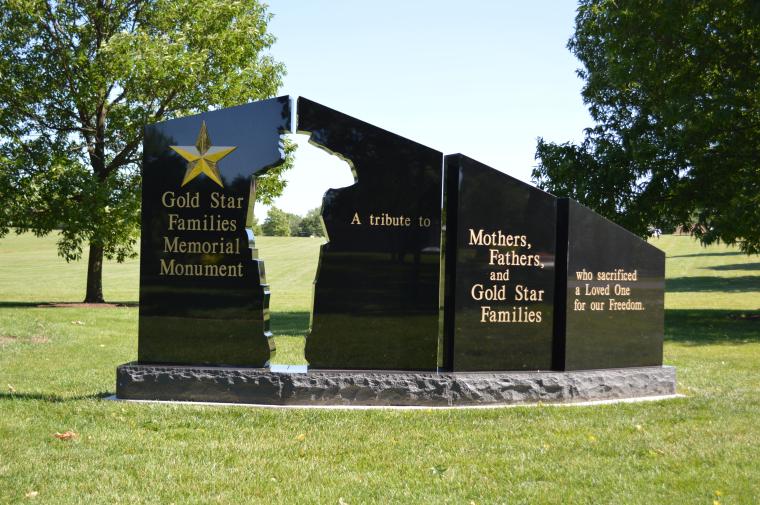
Gold Star Family Monument Veterans Memorial Park, DE

Dedicated in November 2018, this is the newest monument in the park, built to honor the families who have lost loved ones. This smooth black granite commemorative monument features a cut out of a missing soldier. The stone reflects the landscape around it while the cutout depicts the emptiness felt when loved ones are lost in service to our country.


Korean Memorial

Image
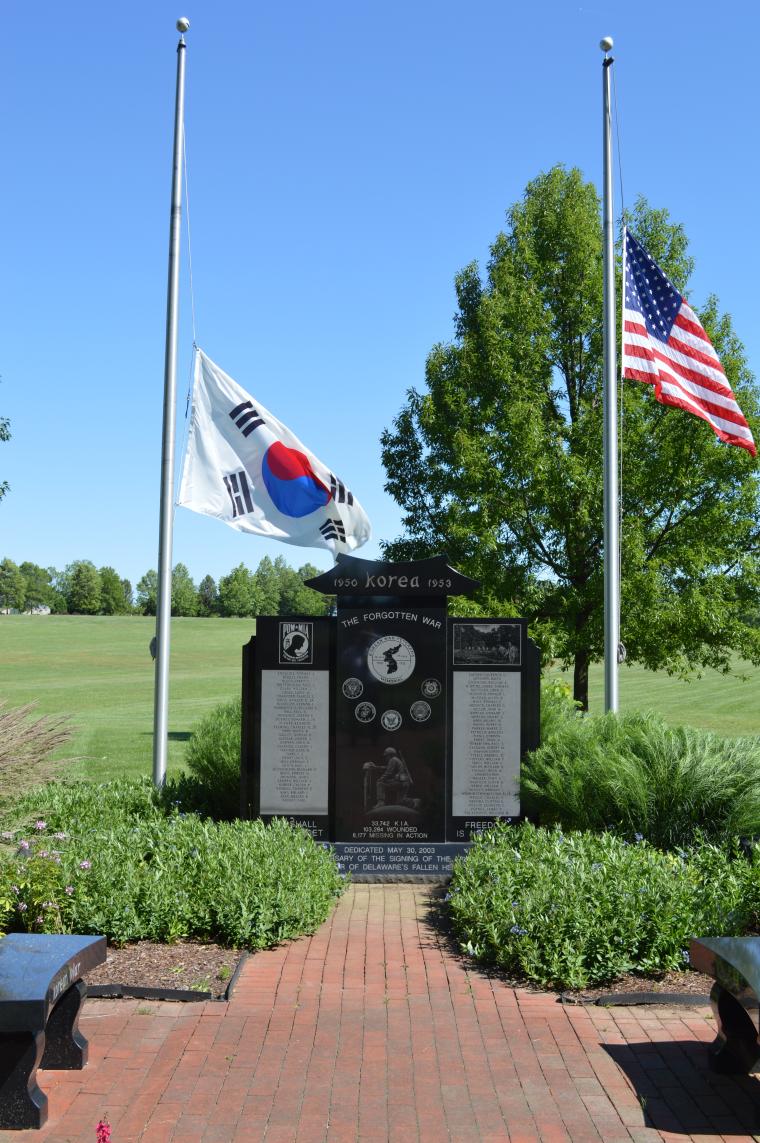
Korean War Monument at Veterans Memorial Park Delaware

The next stop in the park is the Korean War Memorial, which was installed in 2003. Also constructed with smooth black granite, the monument is flanked by the South Korean and American flags. Known as The Forgotten War, the monument displays the insignias of the 5 branches of our armed forces. The Korean War waged from June 1950 until July 1953 and was among the most destructive conflicts of the modern era, with approximately 3 million war fatalities and a larger proportional civilian death toll than World War II or the Vietnam War.

Nearby, you’ll also see the “One Army” Soldier Statue, patterned after an original at the Army War College in Carlisle, PA. The statue honors all soldiers from DE and NJ who were killed, or were MIA in combat since the Korean War.


Vietnam Plaque

Image
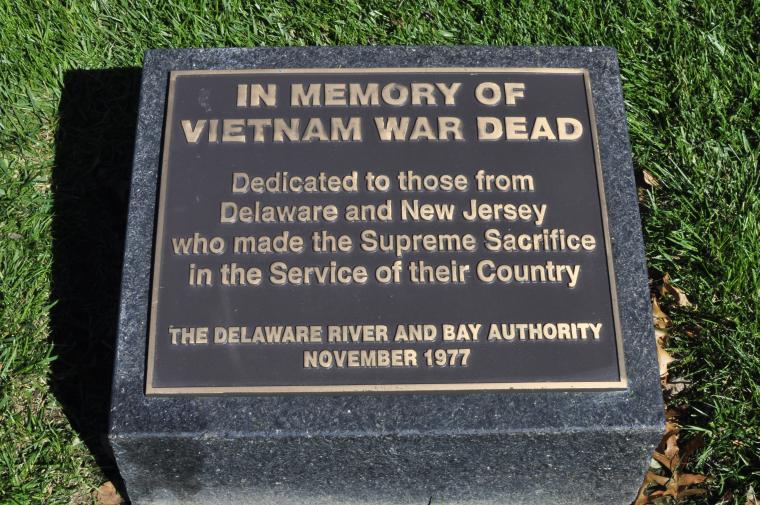
Ground Plaque honoring Vietnam veterans in Veterans Memorial Park, DE

As you walk through the park, you’ll see a somber ground stone dedicated specifically to those who died in the Vietnam War.


Submariners Memorial

Image
Submariner monument at Veterans Memorial Park, DE

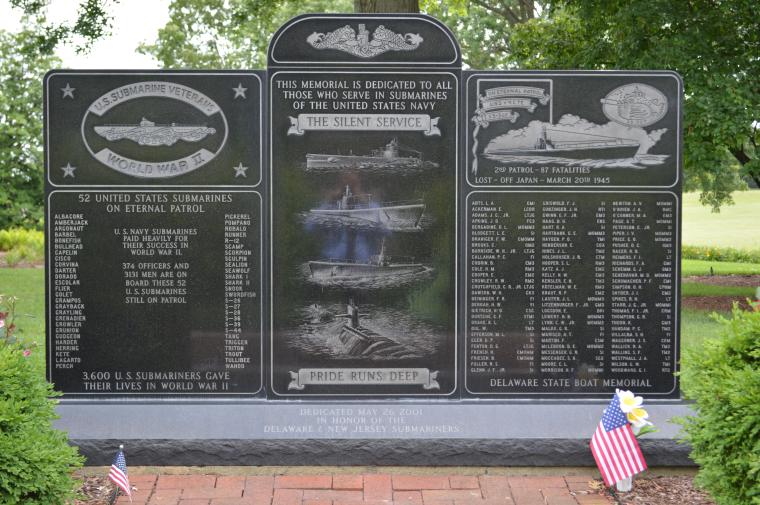
Though we’re now in the center of the park, a quick, but important turn to the left brings you to the Submariners Memorial. Submarines were integral to WWll war efforts, but were often overlooked in memorials. They became dubbed the “Silent Service,” and in May 2001, this detailed black marble monument was created to honor submariners.


Memorial Wall

Image
Memorial Wall at Veterans Memorial Park in New Castle, DE

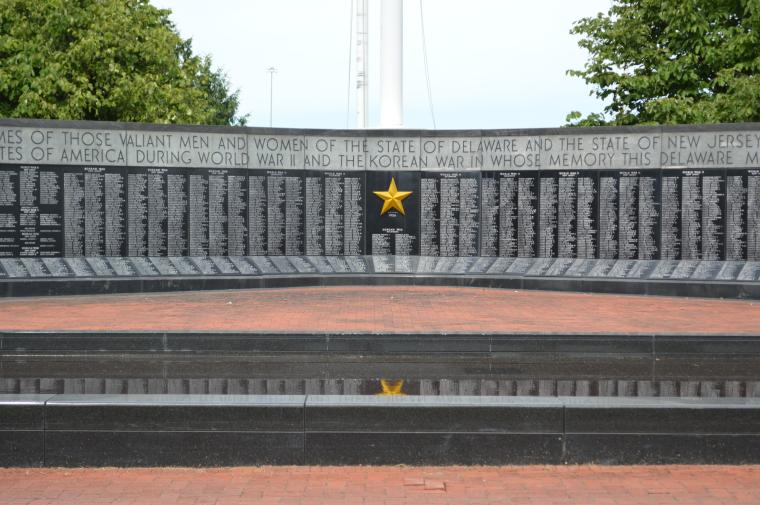
The centerpiece of the park, the Memorial Wall was dedicated in 1956, and lists the names of approximately 15,000 military personnel from both Delaware and New Jersey who paid the ultimate price in both WWll and the Korean War. Each year when in-person events are possible, services are held at the park on both Memorial Day and Veterans Day with close to 400 people in attendance, including all elected officials in Delaware.


Purple Heart Memorial

Image
Purple Heart Memorial

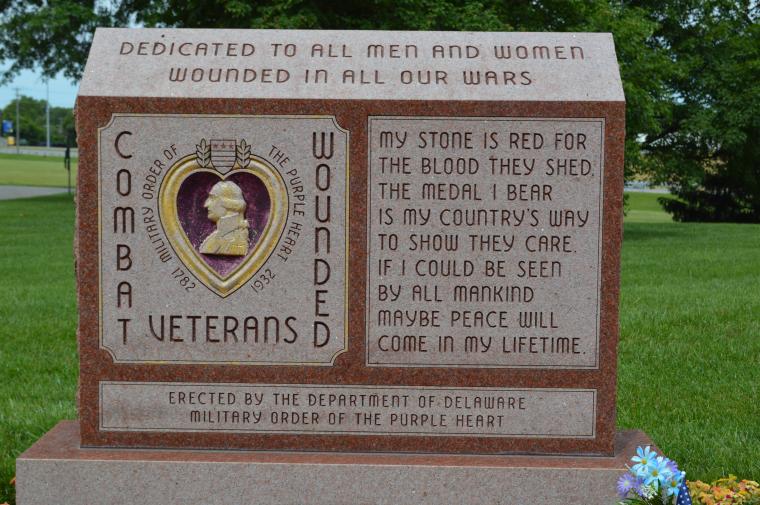
The Purple Heart Memorial is dedicated to those who were wounded in all wars. Unlike other monuments in the park, this one is made of red stone, symbolic of the bloodshed in all wars. It was erected by the Delaware Military Order of the Purple Heart, and hopes for times of future peace over combat.


Blue Star Memorial

Image
Blue Star Memorial at Veterans Memorial Park, DE

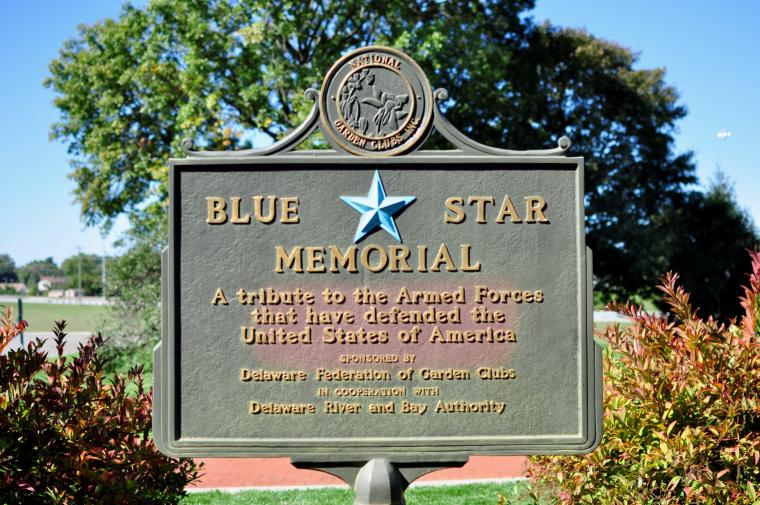
We end our virtual tour of Veterans Memorial Park at the Blue Star Memorial. The Blue Star Memorial is a tribute to the all the Armed Forces that have defended the U.S., and is a fitting final reminder. Whereas a Gold Star can be displayed by families who have lost loved ones in service to our country, the blue star is the symbol of a child in service during any period of war or hostilities. It was first introduced during WWl.

The Man Behind The Highway: Theodore C Freeman

Theodore C. Freeman, a Local Hero

What’s in a name, anyway? If you’ve either boarded or departed from the Lewes Ferry terminal, then you’ve most likely driven on Freeman Memorial Highway. But do you know the story of the man this highway was named for?

Here are a few highlights from the life of the man behind the highway.

Early Years

Freeman grew up and attended high school in Lewes in the late 1940s. During high school, he worked for Mayor Otis Smith as a fish spotter where he would fly PA18s – small single engine aircraft – and spot fish for the fishing boats below.

The US Navy, US Air Force and other Education

After graduating high school, Freeman attended the United States Naval Academy, where upon graduation he accepted a commission in the United States Air Force. Ted later received his masters degree in aeronautical engineering from the University of Michigan and became a test pilot, aerospace research pilot, and flight instructor.

NASA

Freeman was a member of the third class of NASA astronauts, and served key roles in the Gemini and Apollo programs. Tragically, on October 31st, 1964, Freeman passed away in a routine training mission after a striking a large Canadian goose, which sent debris into his engines and brought down his plane. Without heroes like Ted Freeman and others who perished in the line of duty, there may never have been a landing on the Moon in 1969.

Image
Plaque outlining Ted Freeman's achievements and legacy

Check Out The Latest Edition of the Twin Capes Traveller!

Stage Coach Gets Ferried to Delaware

A Mini- Stage Coach & A Tall Ferry Tale

It’s not every day you see a stage coach pull up to the Cape May-Lewes Ferry, but the first day after the 2018 Midterm elections, there she was!  The story behind it, directly tied to the elections, was uniquely Delaware, although as with most Ferry Tales, it also has a New Jersey component.

Image
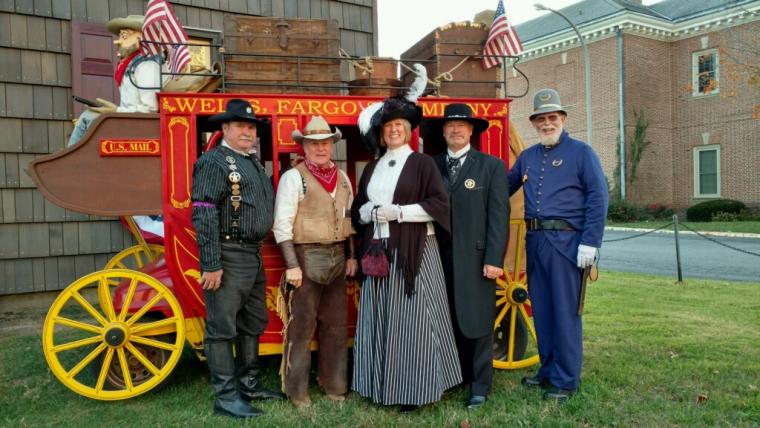
Return Day parade participants with the mini Wells Fargo Stage Coach

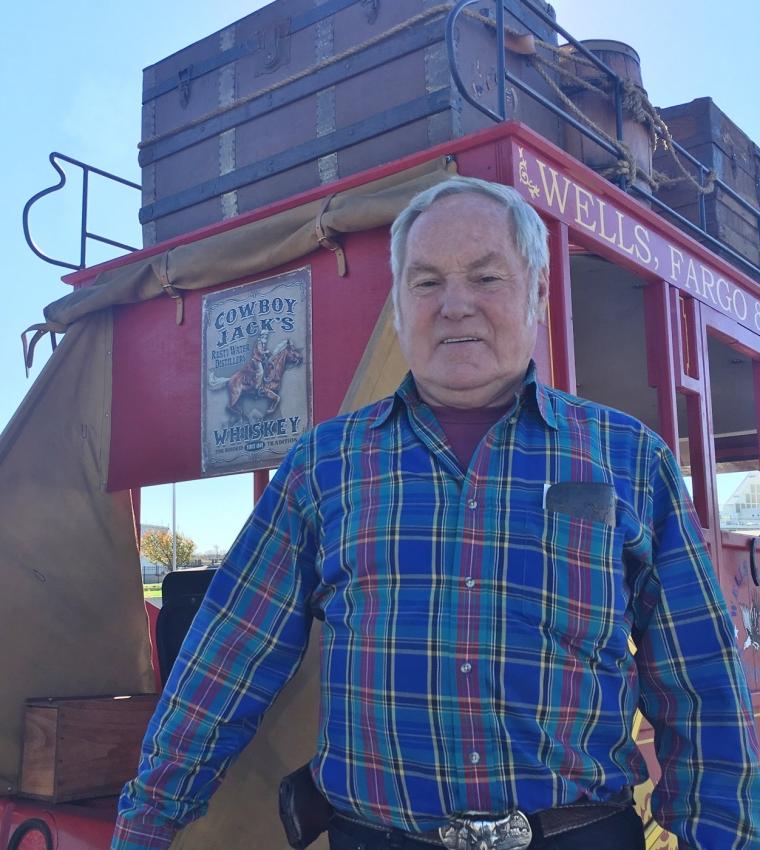
The mini- stage coach at its heart is a golf cart modified by Jack Vliet, a three-time NJ state champion in single action shooting. The vehicle initially did unadorned service as Vliet’s  gun cart during shooting matches.  But, as a member of the Cowboy Action Shooting Club, Vliet soon got the inspiration to decorate the cart to be more thematic to the club’s roots.  Within a few weeks, his plain golf cart was transformed into a bright red, mini Wells Fargo stage coach! 

Two years ago, Robert T. Lee, a fellow shooter and Sheriff of Sussex County, DE, came up to Vliet to entice him into the Sussex County Return Day Parade.  Held every two years, the parade and festival celebrates a Delaware tradition dating back to 1791 when all Sussex County voters had to travel twice to Georgetown, the County Seat. The first trip was to vote and the second was two days later to return and hear the election results when they were turned over from the Sheriff to the Town Crier. 

Image
Jack Vliet with his mini Wells Fargo Stage Coach for Return Day, Georgetown, DE

Return Day is now a Delaware State holiday. In 2018, Vliet was taking the Cape May-Lewes Ferry from his home in Mays Landing, NJ to return for his own second parade in the 103rd Return Day festivities

Vliet officially paid for just himself as the driver, but he had two unnamed passengers in the back seat — mannequin he also designed himself to ride shotgun during parades. One might assume that he gained his talents from years at Bally’s Wild West Casino, but he’s really a 23 year vet of Harrah’s, Atlantic City!  When at the parade, his two passengers take front and center on the coach, and he goes inside to drive it via restored golf cart battery power.  No tows or horses needed to keep this vehicle running!

Sea Glass Stories

Sea Glass: Nature's Recycled Art

Sea glass is the art of nature crafting something from man. It takes approximately seven years of tumbling and tossing in the ocean for disregarded jars, bottles and other pieces of glass to smooth down and gain a frosty coloration, forming into sea glass.

A certain affinity has formed on the east coast for sea glass, and our Lewes Terminal hosts the Mid-Atlantic Sea Glass and Coastal Arts Festival. This event can have about 70 vendors, ranging from art to lawn pieces and of course, sea glass, each vendor with a story to tell.

Here are two stories of interesting vendors from a recent Sea Glass Festival:

Sam Sea Glass

Image
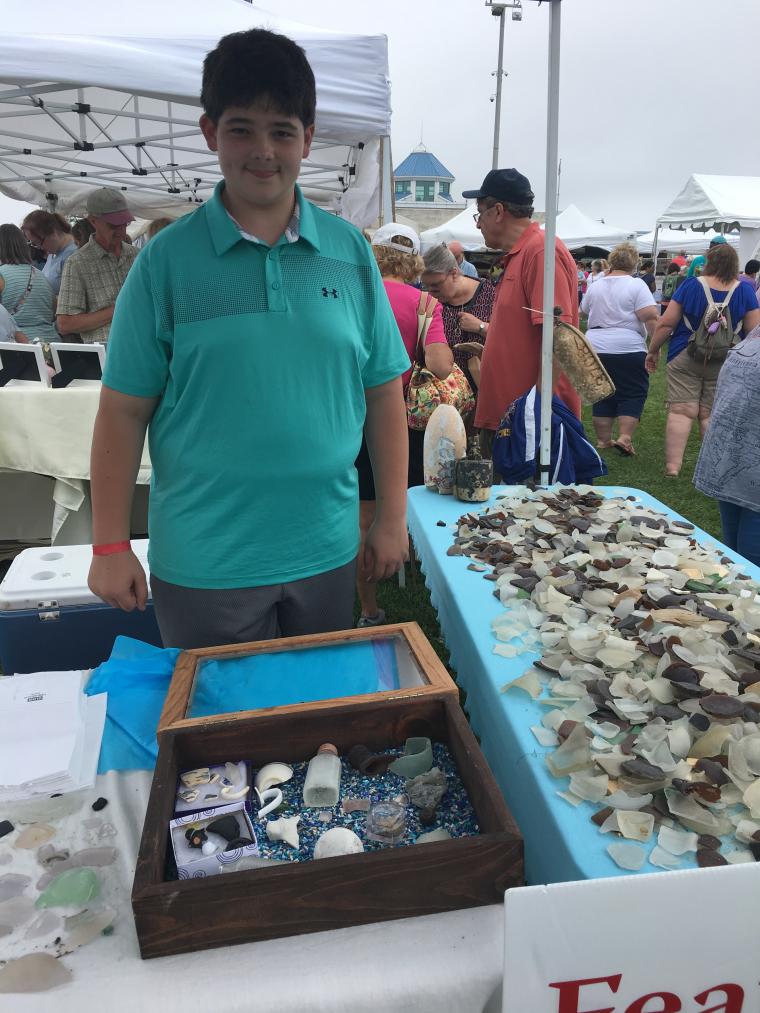
Sam Sea Glass

15-year-old Sam Samero is from Pennsylvania, but still has quite an impressive collection of sea glass for someone who doesn’t live right along the shore. Sam’s neighbors had a summer house in the Chesapeake Beach area in Maryland. Apparently, in this area, only locals know the sweet spots where sea glass is more likely to wash up. Sam’s neighbors showed him these spots when he was younger and eventually, he inherited the whole collection.

His mom makes cement stepping stones for gardens, all with bright designs. When they first inherited the sea glass collection, she attempted to utilize the pieces within her stepping stones, but after it wasn’t working the way she hoped, she allowed Sam to claim the whole collection as his own. While his mom sold her stones at art shows and festivals, Sam began tagging along and setting up tables of his own right alongside his mom.

From there, Sam began collecting his own sea glass to add to the collection, and his pieces have taken on a life of their own. At 11 years old, Sam had won 1st place in the St. Michaels Sea Glass Show in Maryland with a small, black piece that seems to have once been a small glass dog. Experts at festivals and events have estimated that Sam’s collection ranges pieces from the 1600s all the way to the 1980s, washed away from shores as far as China.

Patis-Sea-Rie

Image
European Sea Glass

Suzanna and Ava are sisters from Milano, Italy and come over annually for the Mid-Atlantic Sea Glass and Coastal Arts Festival in Lewes. Ava’s best friend from grade school, Anita, is also part of this group. Anita is from the U.S. but lived in Milano when she was younger, moving back to the states with her parents during high school, but the two always kept in touch.

The three got into sea glass when they were younger, Suzanna always loving to search for pieces along the shores. While of course it still washes up among Italian shores, they said that sea glass is not as common of a hobby in Italy. As Suzanna got into the hobby, her younger sister, Ava started coming with her, eventually bringing her best friend, Anita.

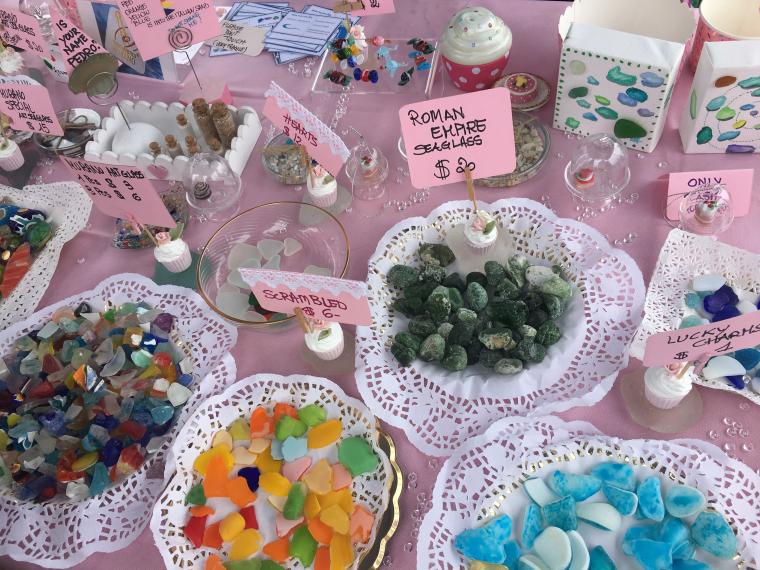
Most commonly, they would comb the Ligurian Sea, but also enjoy traveling down the coast of Italy to search the coast of the Mediterranean Sea. Anita now lives in Lewes, and a few years ago encouraged the sisters to come and visit her and set up a table of their sea glass for the Mid-Atlantic Festival. Now, every year, they come to the states strictly for our festival here (they have never attended another), theme their colorful table in cupcakes, and then make a vacation out of their stay with Anita. The three pride themselves on being the only European table at the event, having Mediterranean Sea glass, as well as sea glass that dates back to the Roman Empire.

Other exciting vendors included one from Greece, who explained she ships over all of her sea glass so that her luggage doesn’t get too heavy, and an antique shop owner from Virginia. We can’t wait to experience the Sea Glass Festival again next year, and hope you will be joining us!

Check Out The Latest Edition of the Twin Capes Traveller!

10 Facts About The NJ Coast Guard

New Jersey has a long history and special relationship with the Coast Guard. It’s one reason Cape May County was designated as a Coast Guard Community in 2015. 

Check out these 9 other milestones that give the U.S. Coast Guard a special place in New Jersey’s heart:

  1. Federally funded life-saving stations graced Cape May County’s shores as early as 1849. Some of these, including Ocean City’s 1885 Life Saving Station 30, are still standing and operate as museums or civic buildings.
  2. The first permanent Coast Guard Air Station was in Cape May in 1926.
  3. In the 1920s, the Coast Guard patrolled the waters of the Jersey coast to foil rumrunners during Prohibition.
  4. During World War II, the Coast Guard Mounted Beach Patrol rode the beaches of Cape May County’s barrier islands on horseback, as well as walked the sandy stretches with German Shepherds to watch for German U-boats.
  5. The only Coast Guard Uniform Distribution Center is located in Woodbine, NJ in Cape May County. The Center ships uniforms, medals, ribbons and accessories all over the world.
  6. Sewell’s Point, the large expanse of oceanfront land where the 350-acre TRACEN (training center) is now located, was once the site of an amusement park, and was a facility shared with the U.S Navy form 1924-1946.
  7. The World War II-era Cutter Tamaroa, which played a key role in the rescue effort documented in The Perfect Storm was sunk in 2016 to help create an artificial barrier reef off the coast of Cape May. The site, about 30 miles off shore, was already home to other downed ships. 
  8. The oldest Coast Guard boat station is in Sandy Hook, NJ. 
  9. Air Station Atlantic City became operational in May 1998. Located at the William J. Hughes Federal Aviation Administration Tech Center at AC International Airport, the station serves as base to the orange USCG helicopters frequently seen along the South Jersey coastline and Delaware Bay. 

In August 2018, the Coast Guard is celebrating it’s 225th birthday.  For more facts of interest not always NJ-based, visit USO.org to see 25 facts for 225 years of Coast Guard history

Check Out The Latest Edition of the Twin Capes Traveller!

Search in CMLF

Cape May Lewes Ferry

Subscribe to our newsletter

Booking Form